
Machine Tool Cable Drag Chain: How to Cut Downtime and Cable Cost
Machine Tool Cable Drag Chain: How to Cut Downtime and Cable Cost
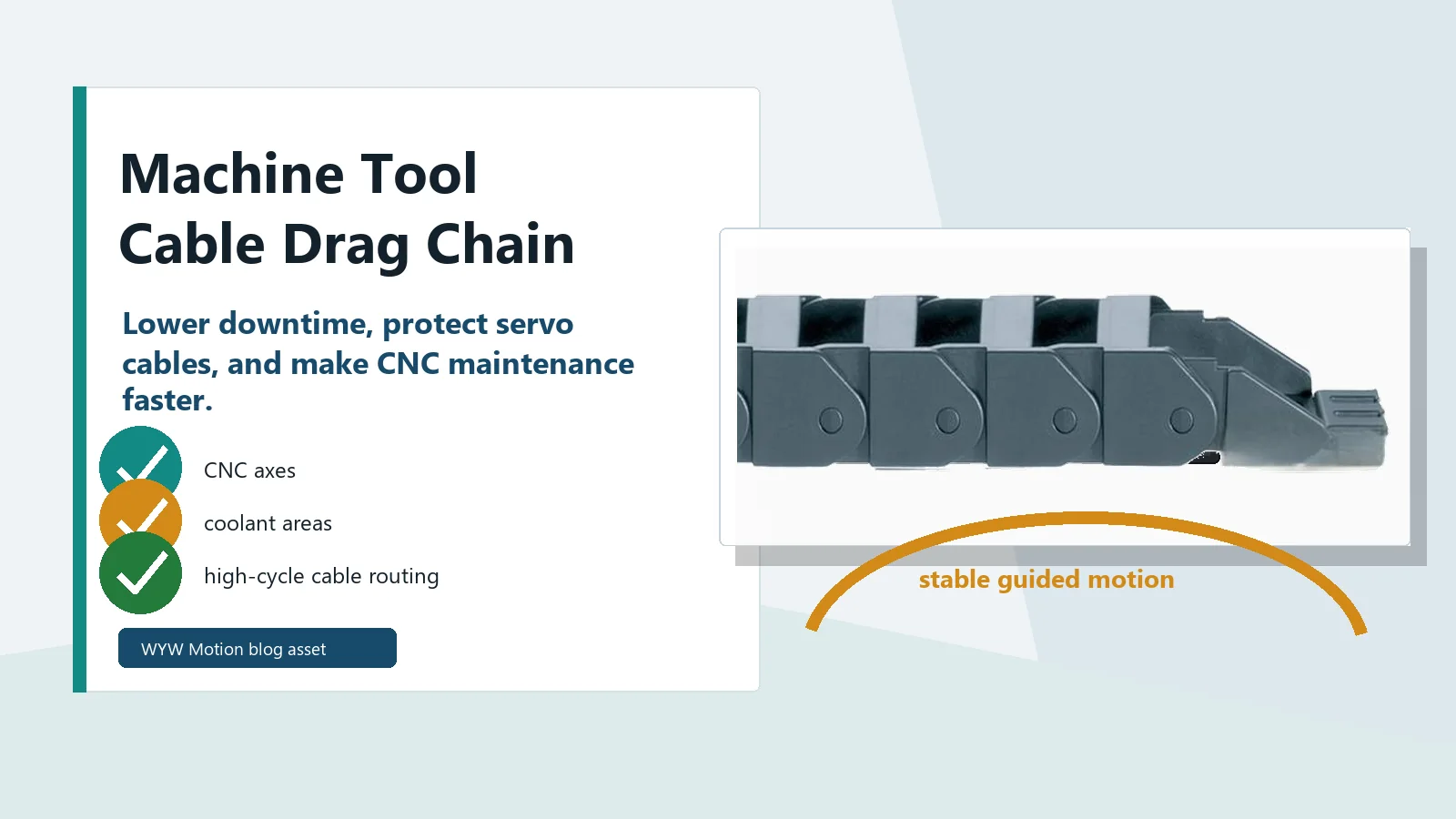
A machine tool cable drag chain is not only a plastic carrier around cables. In CNC machining centers, milling machines, lathes, laser cutters, and automated loading systems, it is a cost-control part. The right drag chain protects servo cables, air hoses, oil tubes, encoder lines, and coolant-exposed wiring from the uncontrolled motion that causes wear, signal faults, and unplanned maintenance.
For many machine tool builders and maintenance teams, the biggest cost is not the drag chain purchase price. It is the spindle time lost when one cable fails, the labor needed to trace a hidden fault, and the repeat repair that happens when the root cable-routing problem was never fixed. A well-selected drag chain turns cable motion into a predictable, inspectable system.
Why Cable Routing Becomes a Hidden Machine Tool Cost
Machine tools are harsh environments for cables. The cable package may move thousands of cycles per shift while sitting near chips, coolant mist, cutting oil, vibration, sharp edges, and compact axis structures. If cable movement is not controlled, even a high-quality cable can fail earlier than expected.
The most common cost drivers include jacket abrasion, conductor fatigue, coolant attack, chip ingress, tight bend radius, excessive cable stacking, and poor strain relief. These problems usually begin small. A cable rubs lightly against a bracket. A hose presses against a signal cable. A bundle twists inside a narrow space. Then the machine develops intermittent alarms, axis errors, or a repair that only appears under motion.
This is why cable protection should be reviewed as part of machine reliability, not only as a purchasing item. Good machine guarding and safe machine design still come first; teams can review official guidance such as the OSHA machine guarding resources when planning access, guarding, and maintenance practices around moving equipment.
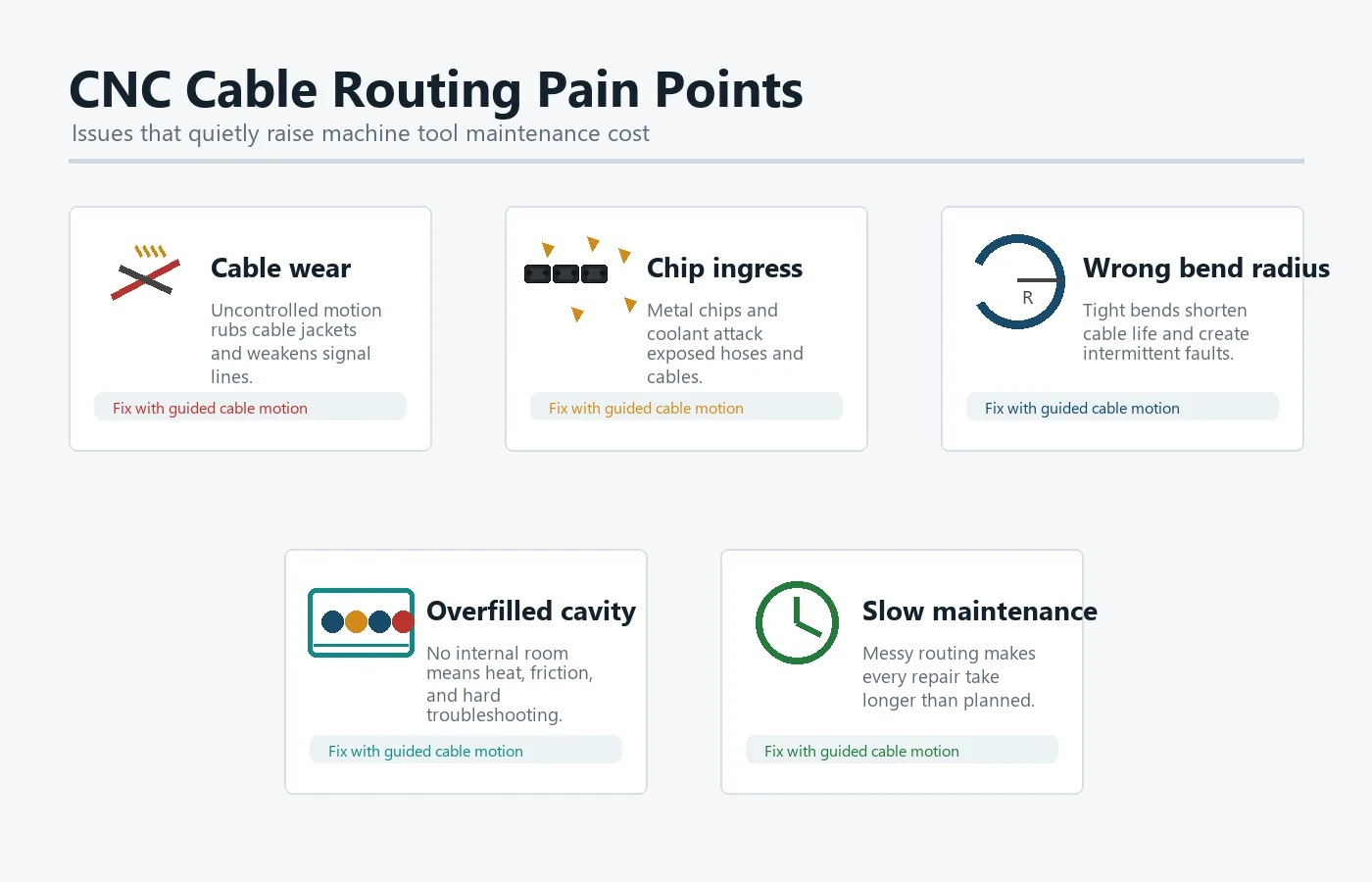
Five Pain Points a Machine Tool Cable Drag Chain Can Solve
1. Cable Wear from Uncontrolled Motion
Loose cable bundles often move differently at every cycle. They rub against brackets, covers, sheet metal, each other, and the machine bed. A cable drag chain guides the cable path so the moving section bends in a controlled arc instead of whipping, twisting, or scraping.
2. Chip and Coolant Exposure
Machine tools produce chips, dust, coolant mist, cutting oil, and cleaning chemicals. Open drag chains are easy to inspect, but enclosed or semi-enclosed drag chains may be better when hot chips or heavy contamination are present. The goal is not to seal every application. The goal is to choose the protection level that matches the real cutting environment.
For applications with continuous chip exposure, compare options on the enclosed cable drag chains page before selecting an open style.
3. Wrong Bend Radius
Servo cables, encoder cables, hydraulic hoses, and pneumatic tubes all have bend-radius limits. When the bend radius is too tight, conductor fatigue and hose stress rise quickly. A machine tool cable drag chain holds the cable package in a repeatable radius, helping the cable stay within the manufacturer’s movement requirements.
4. Overfilled Cable Space
Overfilling a drag chain creates friction, heat, and internal cable rubbing. It also makes maintenance slower because every cable is harder to identify and remove. Correct inner height, inner width, separators, and cable distribution reduce that hidden maintenance burden.
5. Slow Troubleshooting
When cables are mixed together without clear routing, a simple sensor fault can become a long search. A drag chain with organized cable separation makes planned maintenance faster. Technicians can see the cable path, inspect wear points, and replace a damaged cable with less disassembly.
How a Cable Drag Chain Reduces Cost Without Reducing Machine Speed
A drag chain does not make a machine productive by itself. It supports productivity by removing avoidable cable problems from the workday. The cost reduction usually comes from five areas.
First, the chain guides motion so moving cables bend in the same path every cycle. Second, separators keep different cable types from crushing or rubbing each other. Third, strain relief prevents cable force from being transferred into connectors. Fourth, modular links allow local replacement when a section is damaged. Fifth, a clean cable path makes inspection faster during planned maintenance.
If your team already tracks downtime, alarms, or maintenance actions through digital manufacturing systems, cable-related faults can be included in that data. Standards and ecosystems such as MTConnect are often used to connect machine tool data with monitoring and analytics systems. For broader context on connected manufacturing, see the NIST Smart Manufacturing Systems program.
The practical point is simple: once cable faults are visible in maintenance data, the business case for a better cable drag chain is easier to justify.
Selection Checklist for Machine Tool Cable Drag Chains
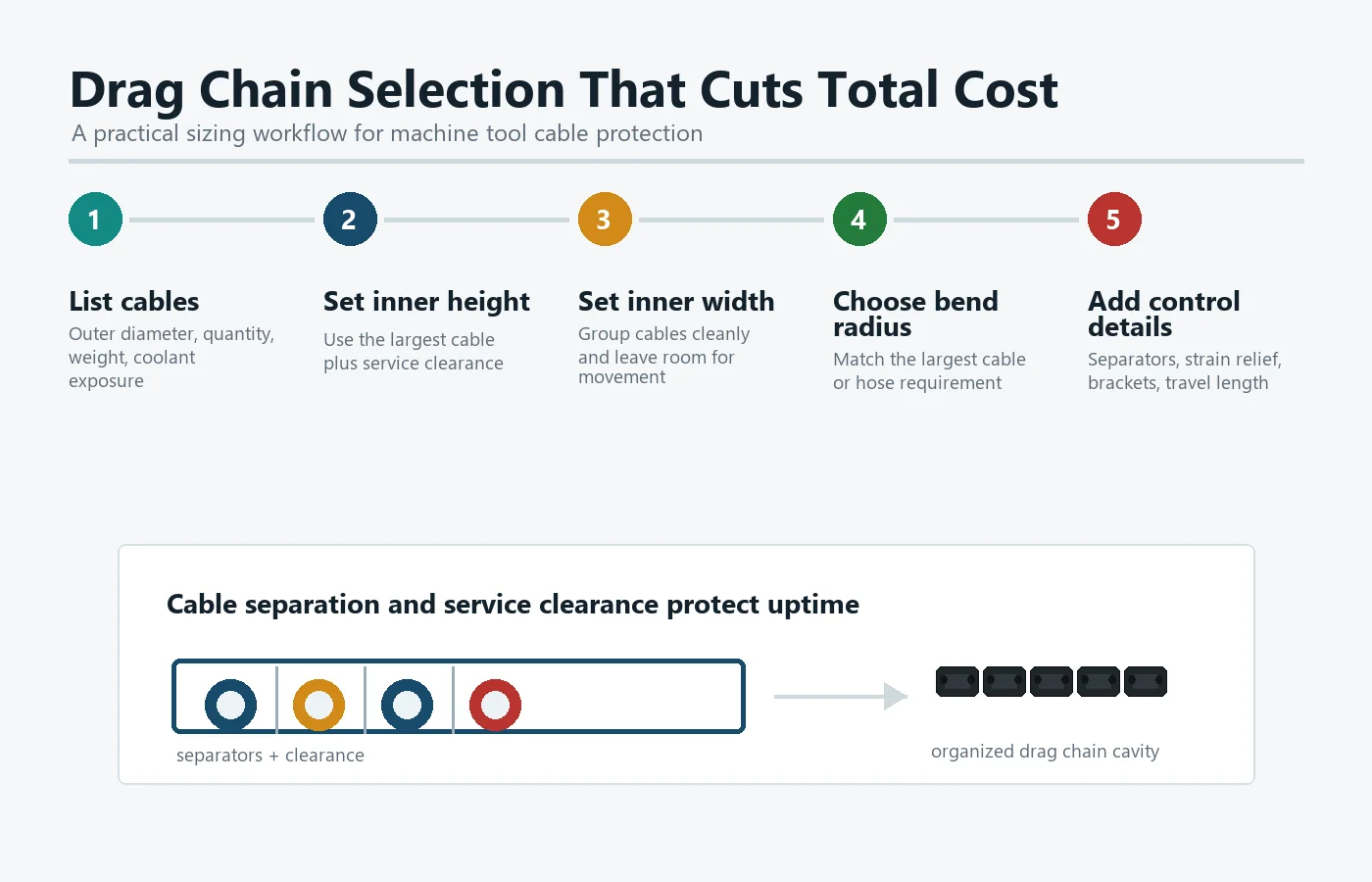
Use the application data first. Do not select a machine tool cable drag chain only by outer appearance.
- List every cable, hose, and tube that must move.
- Record outer diameter, minimum bend radius, weight, connector size, and exposure conditions.
- Choose inner height based on the largest cable or hose plus practical clearance.
- Choose inner width based on cable grouping, separators, and future service space.
- Confirm travel length, unsupported span, mounting direction, speed, acceleration, and available installation space.
- Add separators when power, signal, pneumatic, and hydraulic lines share one chain.
- Add proper strain relief at both fixed and moving ends.
- Review whether an open, enclosed, bridge-style, or custom cable carrier is the best fit.
For a deeper sizing workflow, use the cable drag chain selection guide. If you already know your machine model and cable package, the engineering support team can help check the size before production.
Open vs Enclosed Drag Chain for Machine Tool Applications
Open cable drag chains are often the best choice when the main goal is easy access, fast inspection, and clean cable separation. They are common in CNC axes, automation gantries, packaging equipment, and cleaner machine enclosures.
Enclosed drag chains are better when the cable package needs more protection from hot chips, abrasive dust, coolant splash, and falling debris. The enclosed body reduces direct exposure, but it can also make cleaning and cable access less convenient. That tradeoff should be decided by the actual chip and coolant pattern around the machine.
Use these quick rules:
| Machine condition | Recommended drag chain direction | Cost-control benefit |
|---|---|---|
| Clean internal CNC axis | Open drag chain | Easy inspection and lower maintenance time |
| Hot chips near cable path | Enclosed drag chain | Better cable and hose protection |
| Mixed power and signal cables | Separators inside the chain | Lower interference and less abrasion |
| Long travel or high speed | Application-checked chain size | Better stability and lower replacement risk |
| Frequent cable changes | Openable link design | Faster service and lower labor cost |
You can compare product families on the cable drag chains product page or review machine-specific examples on the CNC machine tools application page.
Installation Habits That Protect the ROI
A good drag chain can still fail early if the installation is poor. The most important rule is to let the cable move naturally inside the chain. Cables should not be pulled tight, twisted during installation, or forced into a cavity that is too small. They should be laid in the neutral position, routed with separation where needed, and fixed with strain relief outside the moving chain section.
Avoid these common installation mistakes:
- Forcing cables into a smaller inner height to save space.
- Mixing heavy hoses and delicate signal cables without dividers.
- Ignoring connector size when planning replacement access.
- Mounting the chain off-center so it pushes against the guide.
- Leaving the moving end without proper strain relief.
- Reusing a damaged bracket or guide trough during a retrofit.
These details look small, but they decide whether the machine tool cable drag chain becomes a long-term reliability upgrade or another maintenance item.
Before and After: What Changes in Daily Maintenance
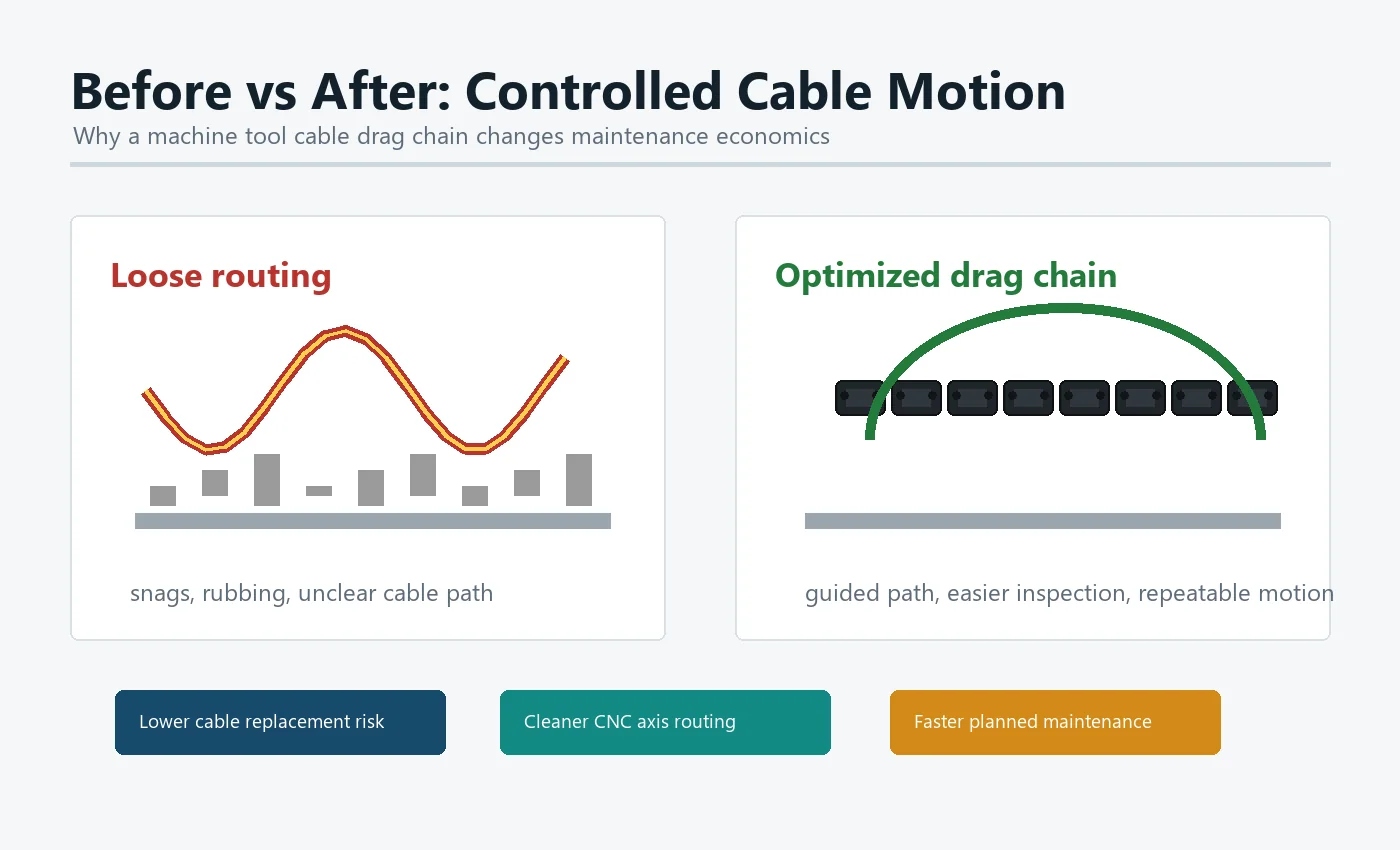
Before a drag chain upgrade, maintenance teams often see unclear cable paths, difficult cleaning, repeated jacket damage, and inconsistent cable movement. After the upgrade, the moving cable section follows a known route. Wear points are easier to inspect. Replacement cables are easier to identify. The machine builder or plant team also has a cleaner design to document for future service.
The best result is not only fewer emergency repairs. It is a more repeatable maintenance process. That is where cost reduction and efficiency improvement meet.
When to Upgrade a Machine Tool Cable Drag Chain
Consider upgrading the drag chain system when you see one or more of these signs:
- Cable jackets show rubbing, cracking, swelling, or flattening.
- Axis alarms appear only during motion.
- Coolant or chips collect inside the cable path.
- The chain is overfilled or cables cannot move freely.
- Technicians need too much time to trace a simple cable fault.
- The machine has been retrofitted with extra cables but the chain was not resized.
- A low-cost carrier was selected, but replacement cost and downtime keep rising.
A retrofit does not always require a complete redesign. In many cases, better cable separation, a corrected bend radius, a more suitable chain style, or improved mounting brackets can remove the main failure point.
Procurement: Lowest Purchase Price vs Lowest Lifetime Cost
It is tempting to buy the cheapest cable carrier when the chain looks like a simple plastic component. In machine tools, that can be the wrong comparison. A better procurement question is: which machine tool cable drag chain reduces the total cost of ownership?
Total cost includes the chain, cables, connectors, installation labor, replacement labor, machine downtime, urgent shipping, and lost production time. A slightly better chain design can be less expensive over time if it prevents repeated cable replacement or shortens maintenance work.
When comparing suppliers, ask for:
- Material and wear-resistance information.
- Inner height, inner width, bend radius, and travel length options.
- Open, enclosed, and separator configurations.
- Bracket and strain-relief options.
- Lead time for standard and customized sizes.
- Support for cable package review before order confirmation.
This is where a specialist supplier can add value. The chain should fit the machine, not force the machine team to fit around the chain.
Conclusion
A machine tool cable drag chain is one of the most practical ways to reduce avoidable cable failures, improve CNC maintenance efficiency, and control long-term machine tool operating cost. The key is to select it from the real application: cable package, bend radius, contamination level, travel length, mounting space, and service needs.
If your machine tool has repeated cable faults, messy cable routing, chip exposure, or slow troubleshooting, review the drag chain system before replacing another cable. A better cable path can turn a recurring maintenance headache into a predictable service routine.
Ready to review your machine? Visit the cable drag chains product page or send your cable list, travel length, and machine photos through the contact page.
FAQ
What is a machine tool cable drag chain?
A machine tool cable drag chain is a guided carrier that protects moving cables, hoses, and tubes on CNC machines, milling machines, lathes, machining centers, and automation equipment.
How does a cable drag chain reduce machine tool maintenance cost?
It controls the cable path, protects the bend radius, reduces rubbing, improves cable separation, and makes inspection easier. These factors can reduce repeat cable failures and shorten troubleshooting time.
Should I choose an open or enclosed drag chain for CNC machines?
Choose an open drag chain when inspection and fast cable access are the priority. Choose an enclosed drag chain when chips, dust, coolant splash, or abrasive debris are the bigger risk.
What information is needed to select the right drag chain?
You need cable and hose quantity, outer diameter, minimum bend radius, weight, travel length, speed, acceleration, installation space, mounting direction, contamination level, and service-access requirements.
Can a drag chain be retrofitted to an existing machine tool?
Yes. Many machine tools can be upgraded with a corrected drag chain size, better separators, improved brackets, or an enclosed cable carrier. A retrofit should be checked against travel length, bend radius, and available installation space.